Rebuilding a newsletter into a habit readers actually kept
~60%
average open rate
+30%
lift over the prior open rate
2,500+
readers on the list
The context
Re-Defined is a Canadian NGO helping immigrants and international students find community, career direction, and belonging. Events were happening, the community was growing, and the mission was deeply relevant to people navigating life in a new country.
But the newsletter wasn't fully reflecting that momentum. The existing content leaned toward broad self-improvement advice — helpful, but generic enough to have come from almost any career newsletter. It didn't capture what made Re-Defined distinct: the lived experiences, emotional realities, and community stories of newcomers in Canada.
Rather than applying through the usual route, I studied Re-Defined's existing newsletter, identified the gap, and built a pitch around a stronger editorial direction. That pitch led to a four-month newsletter internship working directly with the co-founder.
The problem
Three things the newsletter wasn't doing
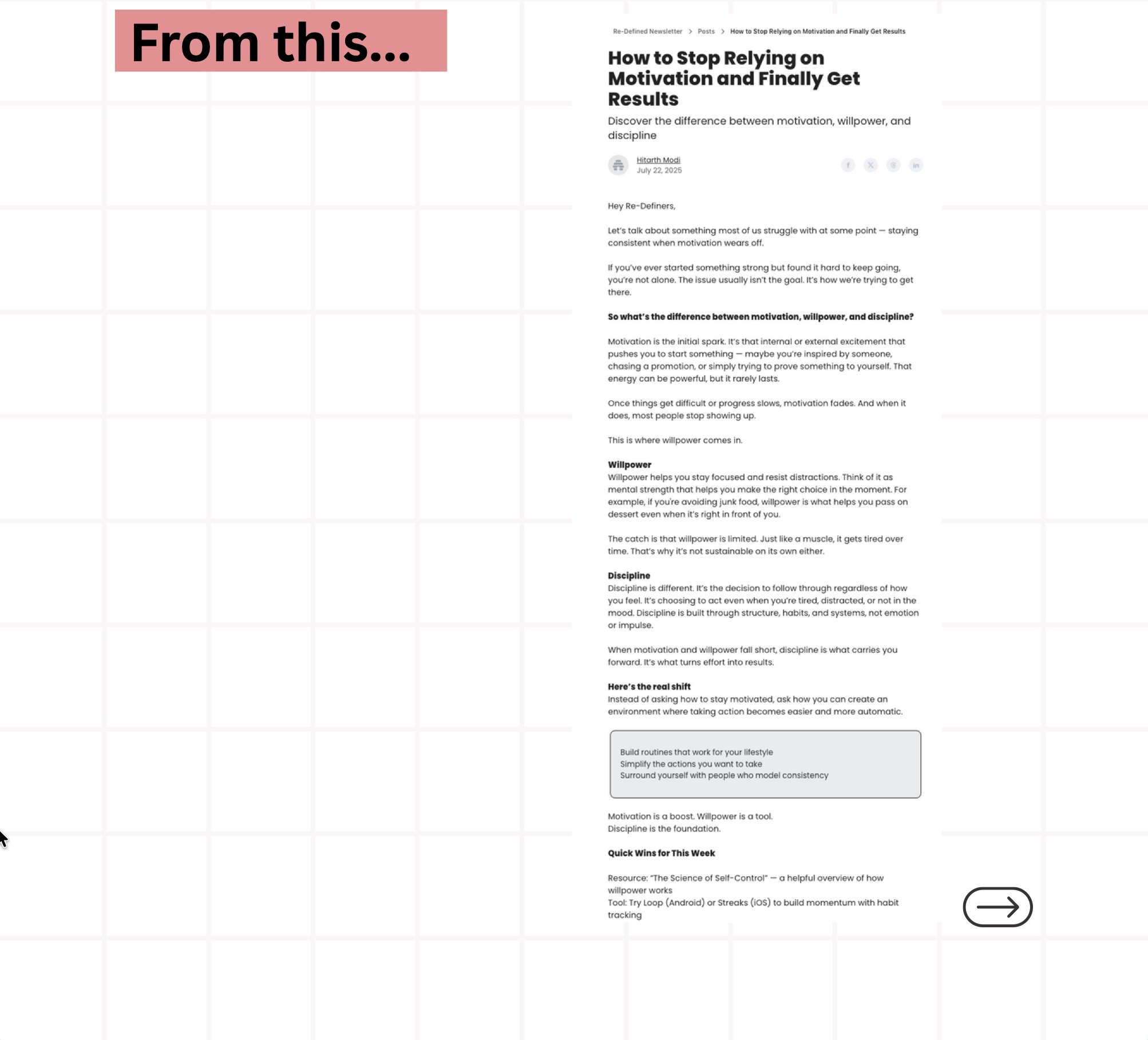
Voice too generic
The content was useful, but it didn't feel specific to Re-Defined's audience. For a community built around immigrants and international students, the newsletter needed to sound grounded in real experiences — not broad motivation that could apply to anyone.
Format not flexible
The newsletter relied on a single long-form article structure. That made each issue one-dimensional and limited its ability to serve different goals: events, member highlights, resources, and action.
Not used as a community channel
Re-Defined had events, member stories, and community energy — but the newsletter wasn't consistently capturing or extending that energy. It was more of a content send than a relationship-building touchpoint.
The strategy
One question guided the whole redesign
"What would make an immigrant or international student open this email and feel like it was written for them — not just sent to them?"
The strategy focused on making the newsletter more specific, more modular, and more community-led — built around three priorities.
Build around community identity
The biggest shift was moving away from generic self-improvement content toward stories, moments, and resources that reflected Re-Defined's actual community — immigrant experiences, event takeaways, member spotlights, and practical resources for newcomers. The goal: make the newsletter feel less like advice from a brand and more like a note from a community someone belonged to.
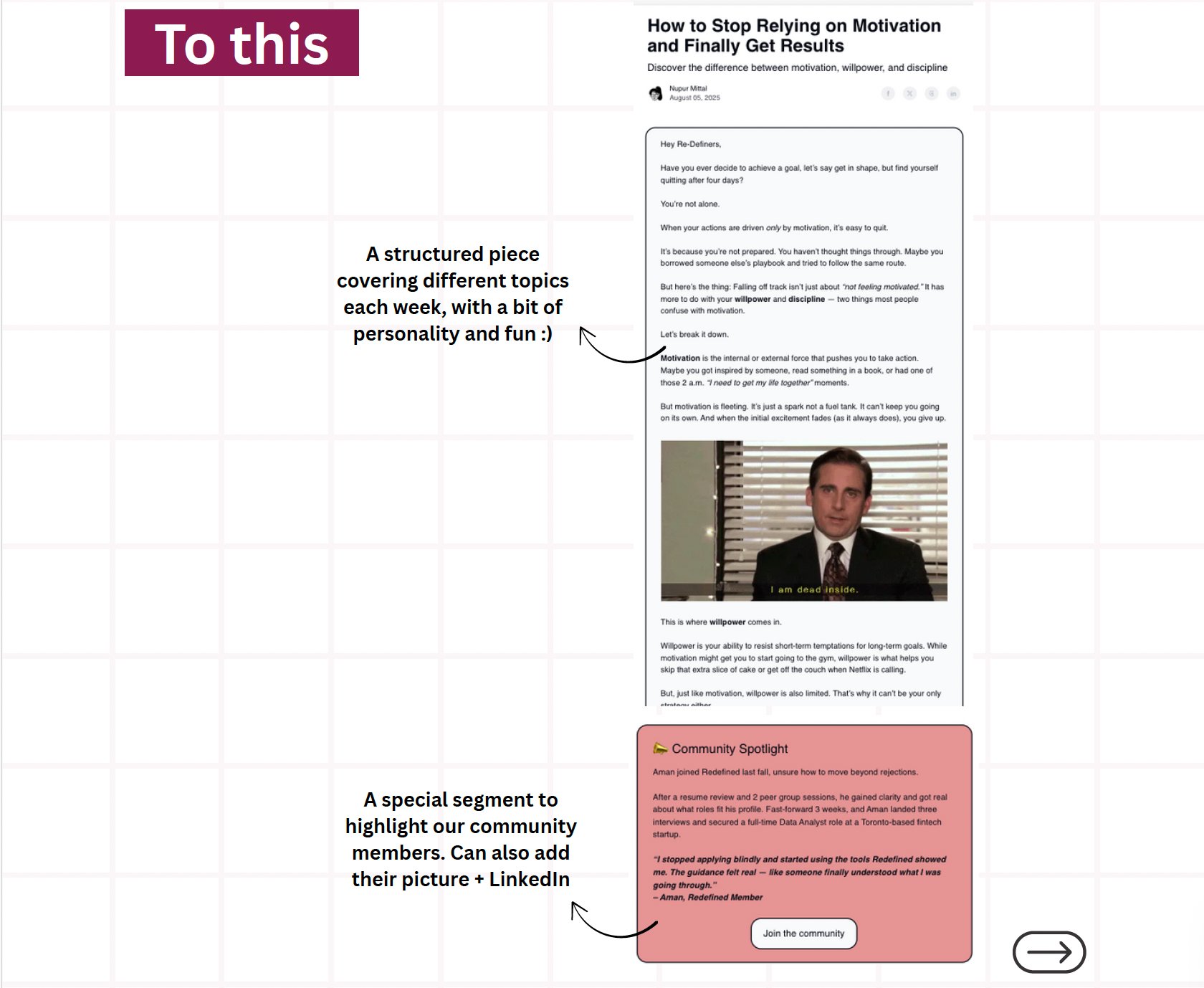
Move from one long article to a modular format
- Opening note — set a warm, relevant tone for each issue
- Community spotlight — highlight real members and make the community visible
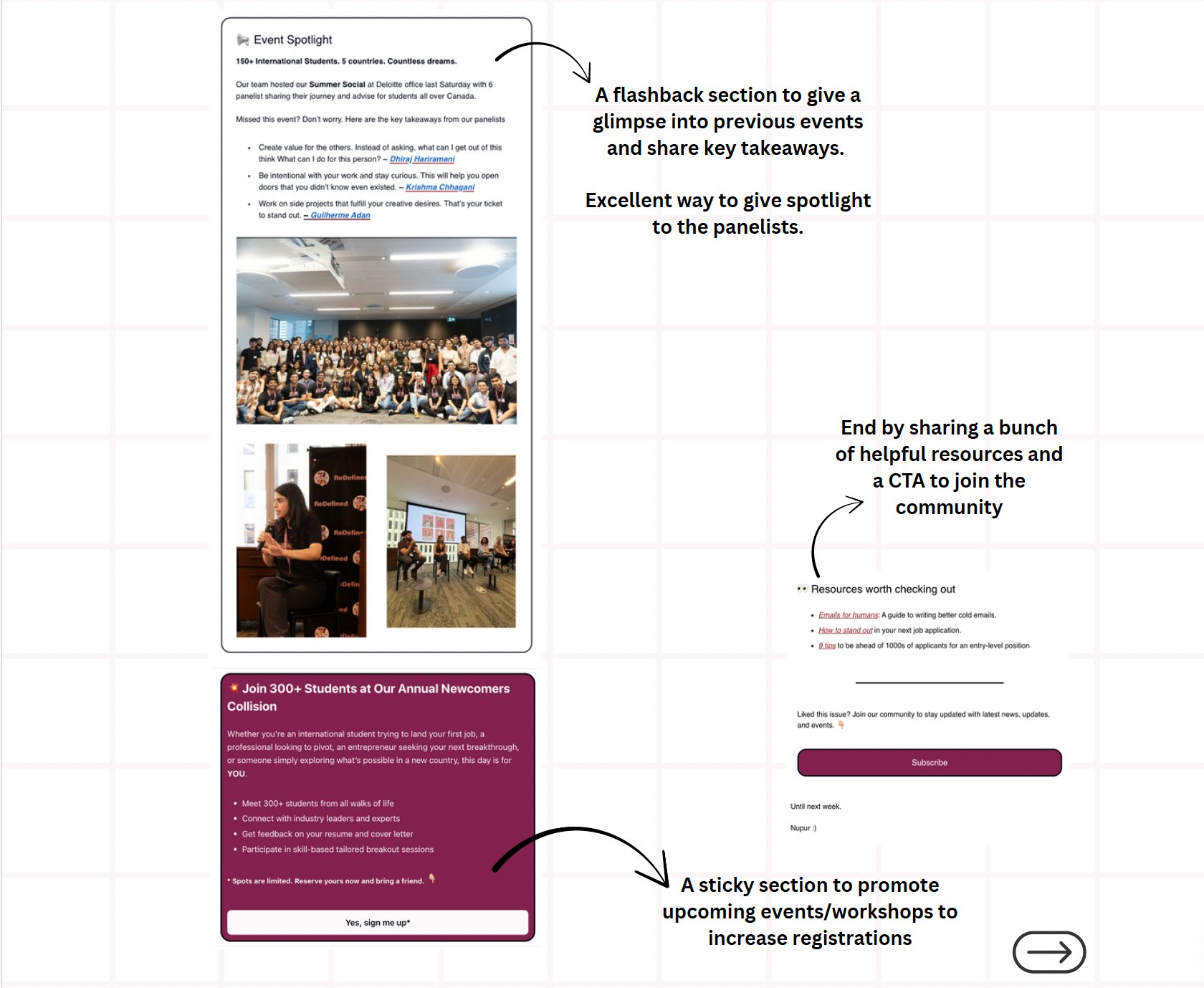
- Event recap — extend the value of past events beyond attendees
- Upcoming events — drive awareness and registrations
- Curated resources — give readers practical support as newcomers
- Clear CTA — guide readers toward the next action
Align content with the event calendar
Instead of treating the newsletter as a standalone content channel, it became part of the event engagement loop — building interest before events, recapping moments after, and keeping the relationship warm in between.
The execution
Redesigned from scratch, built to repeat
Audited the existing newsletter
Identified gaps in voice, structure, and audience relevance before touching anything.
Redesigned the format in beehiiv
Created a modular structure that could be repeated across issues without starting from zero each time.
Built an editorial calendar
Aligned with Re-Defined's event schedule so content supported community moments, not just filled an inbox.
Introduced member spotlights
Made the community more visible and shifted the newsletter from advice-led to people-led.
Curated resources and event engagement ideas
Helped the newsletter support registrations and participation alongside relationship-building content.
Before & after
From a single article to a modular, people-led format
Before — single-article format
After — warmer voice, community spotlight
After — event recap and resources
The takeaway
Community newsletters work best when they sound like the community
The community spotlight section helped shift the newsletter from advice-led to people-led. It created space for members to be seen and gave Re-Defined a way to tell real stories instead of sharing general guidance.
The newsletter also became more useful as an event engagement channel — supporting registrations, increasing post-event visibility, and keeping members connected between touchpoints.